Five Felonies, Thirty Months Later: The Boebert Case and the Retribution Question
Tyler Boebert, the 21-year-old son of Rep. Lauren Boebert, was arrested in Garfield County, Colorado, on Sunday and released the same day on $10,000 bond. He faces five felony counts: sexual exploitation of a child with enticement, sexual exploitation of a child and possession of child sexual abuse material with intent to distribute, sexual exploitation of a child with video, and two counts of contributing to the delinquency of a minor. He is scheduled to appear before Judge Jill McConaughy on Aug. 19.
"I love my son," his mother said in a statement. "We take these allegations very seriously and pray for everyone affected during this challenging time."
Two things should be said plainly before anything else. Tyler Boebert is a private citizen who has been charged, not convicted, and is entitled to the presumption of innocence. And what the affidavit describes is serious: a Safe2Tell tip led investigators to a newly created Instagram account holding sixteen videos and images involving teenagers between 14 and 18, and the charge sheet includes possession of child sexual abuse material with intent to distribute. Nobody should wave that away, and this article will not.
But two other things deserve to be said just as plainly. First, the count at the center of the case involves two teenagers eleven months apart in age. Second, the conduct alleged happened in early 2024, investigators opened the case in early 2024, and the charges arrived on Aug. 6, 2026, roughly thirty months later, with no public explanation for the gap. In between those two dates, Tyler Boebert's mother picked two very public fights with the most powerful man in her party, and lost neither quietly.
That timeline does not prove anything. It does raise a question that deserves to be asked out loud: is this case moving now because the ordinary machinery of justice finally got around to it, or because someone wanted to make a point?
What the affidavit actually describes
According to the arrest affidavit, one of the videos on the account showed Tyler Boebert having sex with a girl eleven months younger than him. He was 18 at the time. She was 17.
Colorado's age of consent is 17, so under state law the relationship itself was legal. The camera is what the felony statute reaches: Colorado law treats any sexually explicit depiction of a person under 18 as child sexual abuse material, whether or not the sex it depicts was lawful, and sharing such a video is a further felony. That law exists for good reason. A 17-year-old whose intimate video ends up on an Instagram account is a victim, full stop, whoever posted it, and the harm does not shrink because the other person in the video was close to her own age.
What has not been made public is who created the account, or what role Boebert is alleged to have played in the other fifteen videos and images, which involved teenagers as young as 14. Those answers matter enormously. If the evidence shows he collected or distributed material involving other minors, the charges are exactly as grave as they sound, and nothing in this article's questions about timing would soften that. If the case rests on his own video with a girl eleven months younger, it sits in the part of the statute where prosecutors exercise the most discretion, because a law written to catch predators necessarily sweeps in teenagers who film themselves. Charged, declined, pleaded down, diverted: which path such a case takes is a choice someone makes. And discretion is exactly where pressure, if there were any, would live.
Thirty months of silence
The conduct alleged in the affidavit dates to January and February 2024. The Safe2Tell tip and the investigation date to the same window. The charges were filed Aug. 6, 2026.
There may be an innocent explanation for a thirty-month gap. Digital forensics backlogs are real. Cases get reassigned, evidence surfaces late, victims need time. Any of those would answer the question. The point is that no one has offered any of them. The 9th Judicial District attorney's office, which reviewed and filed the charges, has not explained why a case built on a 2024 tip about 2024 conduct came to life in August 2026.
Prosecutors are not obligated to narrate their timing. But when the defendant's mother is a sitting member of Congress in open conflict with the president of her own party, timing stops being a housekeeping detail. It becomes the question.
What happened in between
Consider what the same thirty months looked like from Lauren Boebert's side.
On Sept. 2, 2025, she became one of only four Republicans to sign the discharge petition, led by Rep. Thomas Massie and Rep. Ro Khanna, that forced the House to vote on releasing the full Epstein files. She was summoned to the White House and pressured directly, by the president, to take her name off. She refused. The vote happened and passed 427-1. Whatever else is true of her politics, on the specific question of exposing child sex trafficking, Boebert did the thing her party's leadership spent months trying to prevent.
Then came Tina Peters, and the money. Trump has spent more than a year trying to force Colorado to free the former Mesa County clerk, who is serving nine years in state prison for orchestrating the breach of her county's election system. The documented sequence: his Justice Department filed a statement of interest questioning her state prosecution in March 2025; in May he directed DOJ to "take all necessary action to help secure" her release, posting "FREE TINA PETERS, NOW!"; in August he threatened "harsh measures" if Colorado refused; in December he claimed to have "pardoned" her, a state conviction no president has the power to pardon. When none of it worked, the punishment arrived through the budget: Space Command relocated to Alabama in a move Colorado officials called retaliation, funding cut at Boulder's National Center for Atmospheric Research, the bipartisan Arkansas Valley Conduit water project vetoed on Dec. 30, federal disaster declarations denied for Colorado wildfire and flood damage, and a freeze on the state's childcare and food assistance funds in the first week of January. Of the state officials holding Peters, Trump wrote: "May they rot in Hell. FREE TINA PETERS!"
Punishing a state's water projects, weather science, disaster victims, and food assistance to spring one imprisoned loyalist is not a theory about how this White House operates. It is the documented record of how it operates, reported step by step by Colorado Public Radio and The Colorado Sun.
Boebert's response to that record was not deferential. "I must have missed the rally where he stood in Colorado and promised to personally derail critical water infrastructure projects," she said in January. "Nothing says 'America First' like denying clean drinking water to 50,000 people in southeast Colorado, many of whom enthusiastically voted for him in all three elections." She added: "Americans deserve leadership that puts people over politics."
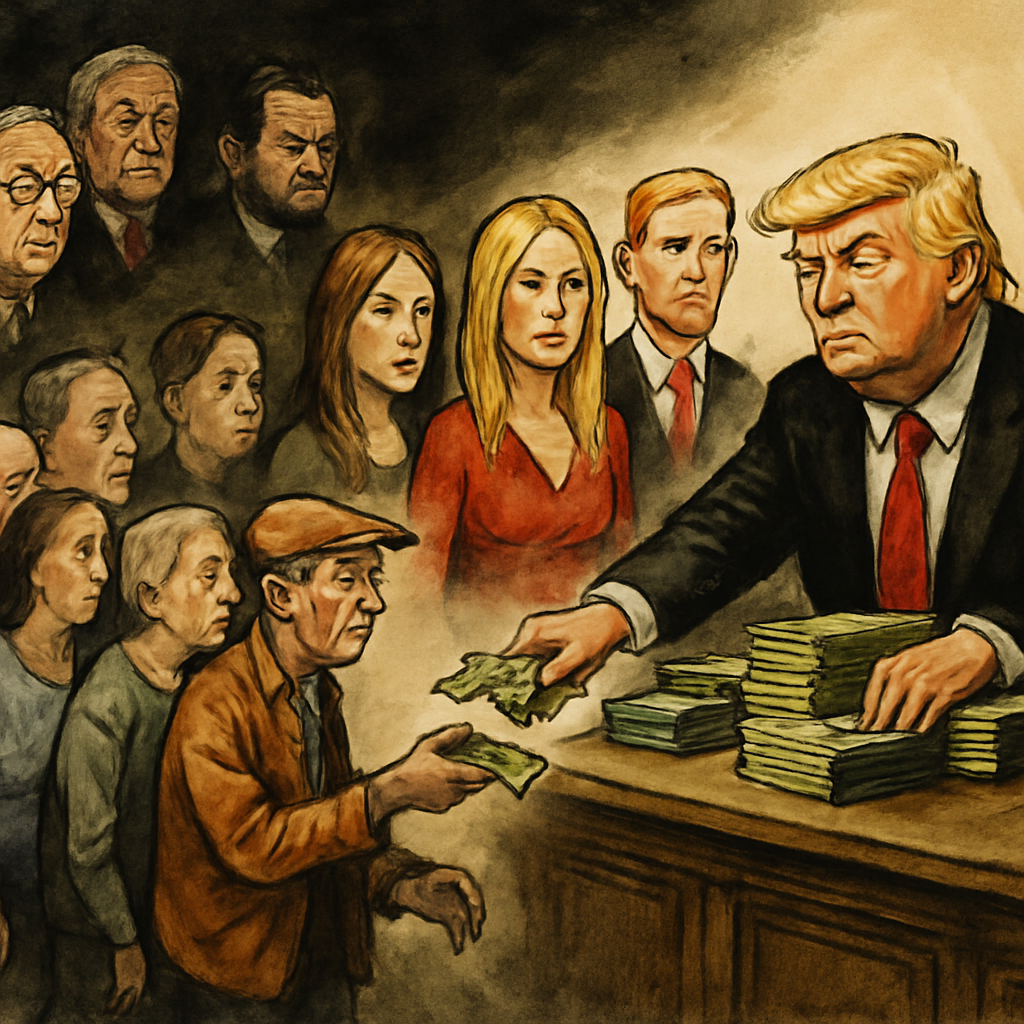
Mock the president's retribution campaign in January. Watch your son collect five felonies from a dormant file in August. Perhaps it is coincidence. The trouble is that this administration has spent eighteen months teaching the country not to assume so.
Asking the question honestly
Here is what an honest version of the question looks like.
The charges were filed by a locally elected Colorado district attorney after an investigation by a county sheriff's office. No evidence has surfaced that anyone in Washington touched this case, and Colorado's prosecutors do not answer to the White House. It is entirely possible this is nothing more than a slow case that finally ripened, prosecuted by an office that would have filed the same charges against any defendant with the same file.
But the reason the question gets asked anyway is that the man at the top of the party has made retribution an explicit governing principle, and Colorado has been his most sustained target. Against that backdrop, a thirty-month-old case that springs to life months after the defendant's mother publicly ridiculed him does not need a conspiracy theory to draw scrutiny. It only needs the silence it currently has.
The fix is equally simple, and it is the same demand this site makes of every prosecutor's office: explain the timing. Say when the file was completed, what moved in 2026, and why charges that could have been filed in 2024 were filed now. If the answer is a forensics backlog, publish it and the question dies. Prosecutorial power exercised without explanation is how legitimate cases come to look like political ones, and how political ones hide among the legitimate.
The Maxwell yardstick
One more piece of context belongs in any story about how this movement's justice system treats sex crimes involving minors.
In August 2025, the Bureau of Prisons moved Ghislaine Maxwell, convicted of conspiring with Jeffrey Epstein to traffic and sexually exploit children and not eligible for release until 2037, from a low-security prison to Federal Prison Camp Bryan, a minimum-security camp that Bureau policy bars sex offenders from absent a special waiver. The transfer came roughly two weeks after Maxwell sat for a private interview with Todd Blanche, then the deputy attorney general and previously Donald Trump's personal defense lawyer, since sworn in as attorney general. A year later, after five letters from Sen. Sheldon Whitehouse and a congressional staff visit, the Justice Department has not produced a single document identifying who ordered the move.
Hold the two cases side by side. A 21-year-old from Rifle, Colorado, answers for what he allegedly did at 18, thirty months after investigators first learned of it, under the full weight of the felony code. The most notorious convicted child sex trafficker in federal custody sleeps at a camp her own conviction should have disqualified her from, and the government that placed her there will not say on whose authority. This is not an argument that the first case should go away. It is an observation about which of the two justice systems seems to need a reason, and which one apparently does not.
Tyler Boebert will get his day in court on Aug. 19, and the seventeen-year-old in that affidavit is owed one too. The prosecutor who filed these charges owes the public one thing more: a reason to believe the calendar, not the president's enemies list, picked the date.
This article is opinion. The factual reporting it relies on is sourced below. Tyler Boebert has been charged and is presumed innocent. His case has no alleged connection to Jeffrey Epstein or Ghislaine Maxwell. No evidence has been reported that any federal official influenced the Garfield County case; this article raises questions about unexplained timing, not conclusions.