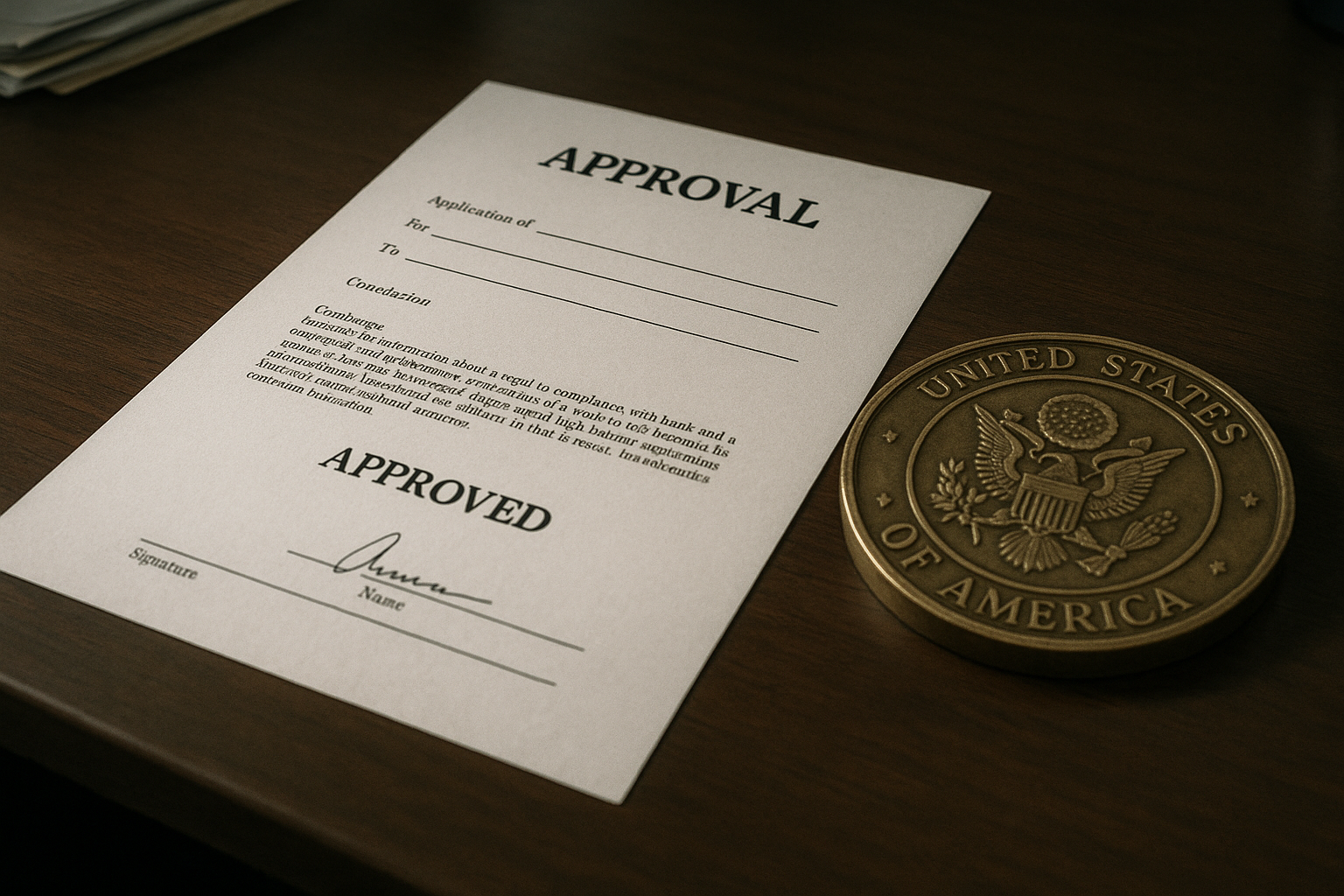
On Friday, August 14, a federal banking regulator whose leader was appointed by President Donald Trump granted preliminary approval for a national bank charter to a company partly owned by Donald Trump.
The Office of the Comptroller of the Currency laid out its reasoning in a 13-page letter, Corporate Decision #1385. Roughly four of those pages respond to public commenters who raised conflicts of interest, foreign ownership, and the Constitution's Emoluments Clause. The agency's answer, restated in several forms, is that those questions are not its problem.
What was actually approved
The applicant is World Liberty Trust Company, National Association, a proposed limited-purpose national trust bank based in Bay Harbor Islands, Florida, and a wholly owned subsidiary of a Delaware entity called WLTC Holdings LLC. The OCC assigned it Charter No. 25407.
Precision matters here, because the charter is narrower than the headlines suggest. This is not a bank that will take your deposits or write you a mortgage. Per the OCC letter, the bank has committed not to become an insured depository institution and not to become a "bank" as defined by the Bank Holding Company Act. It has no current plans to seek a Federal Reserve master account. Its customers will be institutions, not the public.
What the charter does grant is more specific, and more valuable than it sounds. The bank plans to issue USD1, the dollar-pegged stablecoin at the center of World Liberty Financial's business, directly to institutional clients nationwide, taking over that role from BitGo Bank & Trust, the current exclusive issuer. It will custody digital assets in a fiduciary capacity. And as a nationally chartered institution, it can preempt state banking regulation, including state liquidity rules.
In short: the Trump family's crypto venture no longer needs a middleman to put its stablecoin into the financial system, and it answers to Washington rather than to fifty state regulators.
The approval is preliminary and conditional. Final authorization to open requires the bank to clear a preopening examination and satisfy eleven separate requirements. The conditions are not trivial, a $20 million minimum in tier 1 capital, at least $10 million of it in liquid assets, 180 days of operating expenses held in reserve, 60 days' written notice before any significant change to the business plan, and OCC sign-off before appointing any senior officer or director. If capital isn't raised within 12 months or the bank doesn't open within 18, the approval expires.
The ownership question the OCC declined to answer
Trump's connection to the venture runs through a chain of holding companies. According to the president's June 2025 financial disclosure and the company's own website, Trump owns 70 percent of an LLC, the balance held by unnamed family members, that in turn holds 38 percent of the entity that owns World Liberty Financial. That disclosure reported $57 million in personal income from the venture over a period that appears to cover only 2024.
The OCC's position is that none of this is before it. World Liberty Financial, Inc. "is not a party to this application," the letter states, and investors in that company "would not have an investment in, or control over, the Bank." On that basis, the agency set aside commenter arguments about the Emoluments Clause, about review by the Committee on Foreign Investment in the United States, and about the 49 percent stake an Abu Dhabi, backed firm purchased in World Liberty Financial four days before Trump's inauguration.
The separation is cleaner on paper than in the signature blocks. Attached to the OCC's own decision are three "passivity commitments", pledges by indirect investors not to influence the bank's management, personnel, pricing, or policies. One is from DT Marks SC LLC. It is signed by Eric F. Trump, as president. Another is from StringZ Holding RSC (DE) LLC, signed by Hamad Khlfan Ali Matar Alshamsi. A third comes from AMGUS, LLC, signed by managing member Zachary Folkman.
The bank's proposed leadership is likewise drawn from the venture's orbit. The OCC posed no objection to Zachary Witkoff serving as organizer, director, and president, alongside Robert Witkoff and Scott Alper as organizers and directors, with Jeffrey Weiner and Erin Baskett listed as independent directors.
"Career OCC staff reviewed the application"
Three commenters argued the bank could receive favorable treatment because the Comptroller of the Currency is a presidential appointee. The agency's rebuttal leans almost entirely on process: approvals of this kind "are made under authority delegated by the Comptroller to career staff," and "career OCC staff reviewed the application for consistency" with the applicable requirements.
Consistent with that, the letter is signed not by Comptroller Jonathan Gould but by Stephen A. Lybarger, Senior Deputy Comptroller for Chartering, Organization & Structure.
Whether that distinction carries weight depends on how much independence one credits to career staff inside an agency Gould has substantially reshaped. Since taking office he has approved roughly a dozen crypto trust charters, cut target approval times from as long as two years to a goal of 120 days, and reduced headcount by more than a quarter, according to NOTUS, with the cuts falling heavily on senior management. Asked in February by Sen. Chris Van Hollen (D-Md.) about political pressure, Gould replied: "If you're suggesting the president would do anything inappropriate or illegal, then I reject that assertion."
Sen. Elizabeth Warren (D-Mass.) had asked the OCC in January to halt the application. Gould declined, saying the agency would proceed on its normal timeline without regard to politics.
It is also worth noting the scale of public participation the letter records: seven comments from four commenters. Three of those commenters argued they had been given neither enough information nor enough time to comment meaningfully. The OCC's response was that they had nonetheless managed to file "voluminous comments."
The reaction
Warren called the approval "the most brazen act of self-dealing our financial system has ever seen," as reported by outlets covering her statement, and said Congress "cannot allow it to stand." She announced plans to introduce legislation with Sens. Angela Alsobrooks (D-Md.) and Ruben Gallego (D-Ariz.), the Ending Presidential Corruption in Banking Act, barring senior government officials from owning or controlling a bank. "We have never seen financial conflicts or corruption of this magnitude," she said.
Patrick Woodall, managing director at Americans for Financial Reform Education Fund, argued in a statement that the OCC "exceeded its statutory authority and longstanding judicial precedent" in granting the charter. His central objection is structural rather than partisan: "The Trump OCC cannot credibly or impartially supervise or examine the Trump family crypto bank, make sure it operates safely and soundly, maintain adequate reserves for the Trump stablecoin, or protect customers from unfair or deceptive practices." AFREF also pointed to World Liberty's business relationships with convicted money launderers, some later pardoned by Trump, a reference that includes Binance founder Changpeng Zhao, pardoned in October 2025, whose exchange holds a majority of USD1 in circulation.
World Liberty Financial rejects the premise. Spokesperson David Wachsman has said that despite the company's ownership, "none of its leadership or employees work for the U.S. government, and there are no conflicts of interest," and that the charter subjects the bank to "robust and permanent regulatory oversight from the OCC," including examination, anti-money-laundering rules, and the Bank Secrecy Act. White House counsel David Warrington has said Trump has "no involvement in business deals that would implicate his constitutional responsibilities." The company has said Trump has had no involvement in World Liberty Financial since taking office.
There is also a defense of the underlying policy that has nothing to do with Trump. Norbert J. Michel of the libertarian Cato Institute has argued that prior OCC leadership left stablecoin issuers in regulatory limbo for years and that faster chartering produces real benefits, quicker settlement, lower transaction costs. Michel has said he does not know enough about the specifics of Trump's firm to judge whether this particular charter should have been approved. That caveat is the whole difficulty: the case for chartering crypto trust banks in general is a separate question from whether this one could have been denied.
What to watch
The charter has not been finalized. The bank must still raise capital, clear a preopening exam, and meet every condition in the letter before it can open its doors, and the OCC retains the right to "modify, suspend, or rescind" the preliminary approval in the meantime.
The harder question is the one the OCC's letter answers only by definition. The agency says career staff will supervise the bank, examine its books, verify its stablecoin reserves, and enforce the law against it, exactly as with any other national trust bank. Those staff report, ultimately, to an appointee of a president whose family stands to profit from the institution being examined.
Nothing in Corporate Decision #1385 addresses that. By the agency's own account, nothing in it had to.
---
This article is based on the OCC's decision letter and contemporaneous reporting. Quotes from Sen. Warren reflect statements as reported by news outlets covering the August 14 approval.