She Pocketed a Slain Officer's Statue Fund. Trump Pardoned Her Anyway
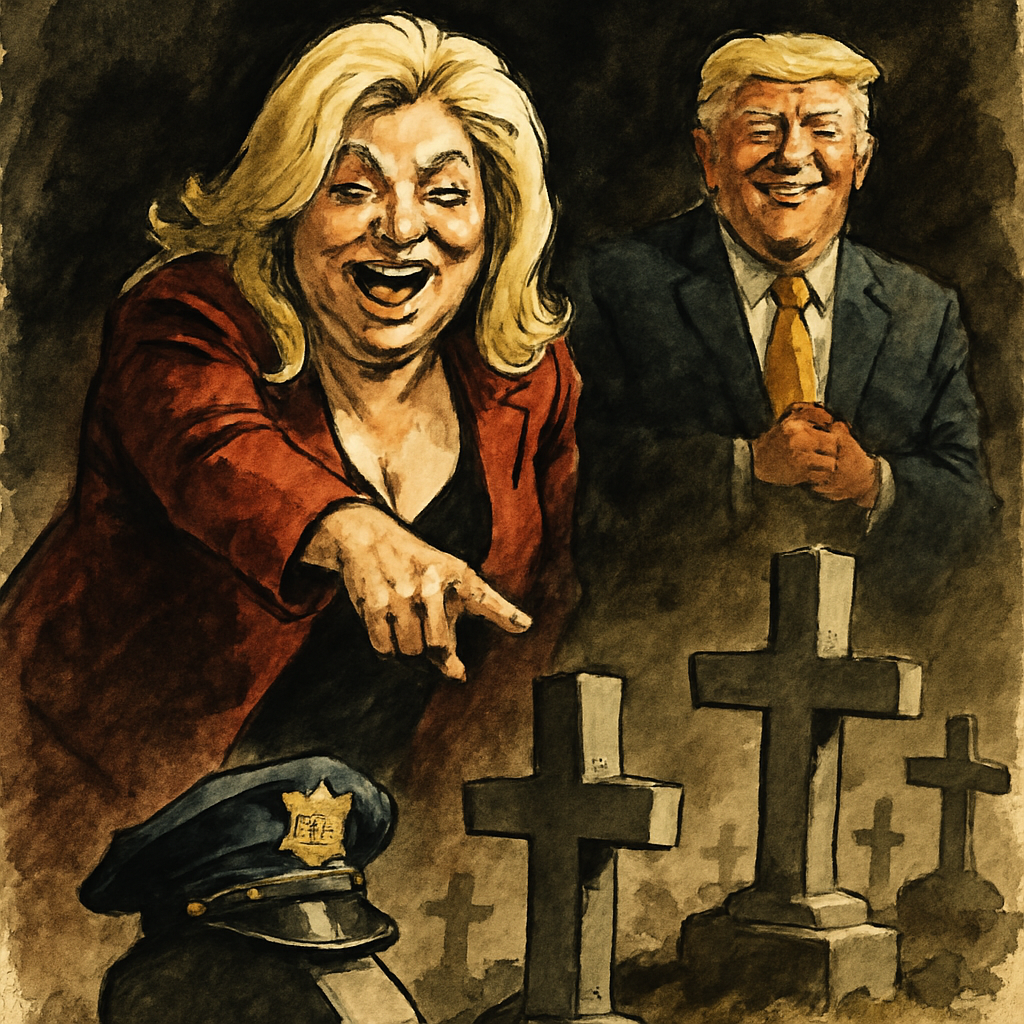
In June 2014, Las Vegas police officers Alyn Beck and Igor Soldo were ambushed and killed while eating lunch at a pizza restaurant; their killers went on to murder a civilian at a nearby Walmart before dying in a shootout. The killings horrified Las Vegas, and a memorial statue of Beck became a rallying point for a grieving community.
Michele Fiore, then a firebrand Nevada politician sometimes called "Lady Trump", raised more than $70,000 from Nevadans for that statue. Federal prosecutors proved at trial that the statue was actually paid for by Olympia Companies, a private developer, while the donations Fiore collected were converted to cash and spent on her rent, cosmetic surgery, and her daughter's wedding. "Michele Fiore used a tragedy to line her pockets," prosecutor Dahoud Askar told jurors. In October 2024, a federal jury convicted her of six counts of wire fraud and one count of conspiracy to commit wire fraud.
She never served a day. In April 2025, three weeks before sentencing, where she faced the possibility of decades in prison, President Donald Trump granted Fiore a "full and unconditional pardon."
The pardon paid twice
The pardon did more than keep Fiore out of prison. According to her own attorneys, cited by the Las Vegas Review-Journal, it also relieved her of any obligation to repay the donors she defrauded, restitution a judge would likely have ordered at sentencing.
The financial upside didn't stop there. Fiore had been suspended from her position as a justice of the peace in Pahrump, Nevada, during her prosecution, but she kept collecting her paycheck. Nye County officials say she has been paid roughly $194,000 in salary and benefits since her July 2024 indictment. Even after losing her re-election bid in July 2026, she remains on the payroll until her term expires.
Nevada's Commission on Judicial Discipline was blunt in its May 2025 suspension order: after becoming a judge, Fiore "continued to defraud the donors by keeping donations to which she was not entitled and continued to fail to notify them she used their funds for personal expenses instead of for the statue."
Fiore has maintained her innocence throughout, pleading not guilty and claiming in a Facebook statement that the federal government and "select media outlets" waged a decade-long conspiracy to "target and dismantle" her life. Nevada Democratic Party executive director Hilary Barrett called the pardon "reckless" and "a slap in the face" to law enforcement. Fiore, for her part, told the Review-Journal after her election loss: "You'll probably see me in Washington, D.C. a bit more often."
One name on a long list
Fiore's case would be remarkable on its own. It is not on its own. Since returning to office in January 2025, Trump has granted clemency to more than 1,800 people, and the roster of beneficiaries convicted of fraud, many of them donors, allies, or the politically connected, has grown steadily:
Trevor Milton, founder of electric-truck maker Nikola, was convicted of securities and wire fraud for misleading investors and sentenced to four years. Trump pardoned him in March 2025, months after Milton and his wife donated more than $1.8 million to Trump's re-election effort. Prosecutors had asked the court to order roughly $660 million in restitution to Nikola shareholders, plus about $15 million to a separate wire-fraud victim. The pardon, issued before the court could finish the restitution process, remitted "any and all" restitution.
Todd and Julie Chrisley, the reality-TV stars convicted in 2022 of bank fraud and tax evasion, jointly owed more than $22 million in restitution. Trump granted both full pardons in May 2025.
Devon Archer, convicted of defrauding the Oglala Sioux Nation in a $60 million bond scheme, owed $43.4 million in restitution. Pardoned in March 2025.
Jason Galanis, Archer's co-conspirator, sentenced for securities and investment-adviser fraud with roughly $84.8 million in court-ordered restitution across two judgments, had his sentence quietly commuted in March 2025.
Carlos Watson, the Ozy Media founder facing a 116-month sentence for securities-fraud and wire-fraud conspiracy, had his sentence commuted in March 2025, cutting off roughly $36.8 million in restitution.
Lawrence Duran, co-owner of a Miami company at the center of a $205 million Medicare fraud scheme, one that steered vulnerable mental-health patients into sham treatment for kickbacks, was serving a 50-year sentence with $87.5 million in restitution when Trump commuted it in May 2025.
Paul Walczak, a Florida nursing-home executive who withheld $10.9 million in payroll taxes from his employees' paychecks and spent the money on a yacht and luxury shopping, was pardoned in April 2025-12 days after sentencing, and less than three weeks after his mother attended a $1 million-per-person fundraising dinner at Mar-a-Lago.
George Santos, the expelled congressman who pleaded guilty to wire fraud and aggravated identity theft, had his 87-month sentence commuted in October 2025, freeing him after roughly three months in prison.
Glen Casada and Cade Cothren, the former Tennessee House speaker and his chief of staff, convicted in a federal public-corruption case that included honest-services fraud, received full pardons in November 2025.
Adriana Camberos, convicted of mail and wire fraud in a counterfeit-goods conspiracy, and previously granted a commutation by Trump in 2021 for an earlier conviction, was pardoned again in January 2026.
The bill lands on victims and taxpayers
The cumulative cost of these acts of clemency is not abstract. House Judiciary Committee Democrats calculated in June 2025 that Trump's pardons had already wiped out roughly $1.3 billion in restitution, fines, and forfeitures. By March 2026, an analysis published by California Gov. Gavin Newsom's office, a political adversary of the president, but one citing court records and Justice Department clemency warrants, put the figure at nearly $2 billion across Trump's two terms. The same analysis noted that the 80 people pardoned by President Biden over four years carried roughly $688,000 in combined financial penalties.
When the crime is Medicare fraud, payroll-tax theft, or defrauding government programs, the ultimate victim is the taxpayer. When the crime is securities fraud, it is ordinary shareholders. And when the crime is soliciting donations for a murdered police officer's memorial, the victims are the citizens who gave in good faith, people who, thanks to a presidential signature, will never be repaid.
The Constitution gives presidents nearly unreviewable pardon power, and every modern president has been accused of misusing it, including for figures like Marc Rich under Bill Clinton and Charles Kushner under Trump's first term. What distinguishes the current wave, critics across the legal spectrum argue, is its scale and its pattern: clemency flowing disproportionately to the wealthy, the connected, and the loyal, with victim restitution erased as collateral damage.
Officer Alyn Beck got his statue, because a private developer paid for it. The woman convicted of taking the public's money for it got a pardon, kept the donations, kept her salary, and says she may be spending more time in Washington.