This is an opinion and analysis piece. Factual claims are sourced below.
For four years, one number defined Republican politics: $17 million. That was the sum House investigators said Hunter Biden, his relatives, and his business associates collected from foreign sources in China, Ukraine, and Romania. Around it, a party built a machine. Chairman James Comer's Oversight Committee produced bank records, subpoenas, and press conferences. The phrase "Biden Crime Family" entered the Congressional Record. Comer declared in January 2025 that Joe Biden "will go down as the most corrupt president in U.S. history."
The investigation never established that anyone broke a law. PolitiFact's review of the bank-records memo found it "did not provide evidence that Hunter Biden or other Biden family members violated the law," and no evidence emerged that Joe Biden acted improperly or profited from his son's contracts. The committee itself stopped short of alleging illegality. What it alleged was something subtler and, in its way, more damning: that proximity to presidential power had been converted into private money, and that the conversion was itself the offense, regardless of whether a statute had been broken.
That was the standard. It is worth holding onto, because it has since been quietly retired.
The number that replaced it
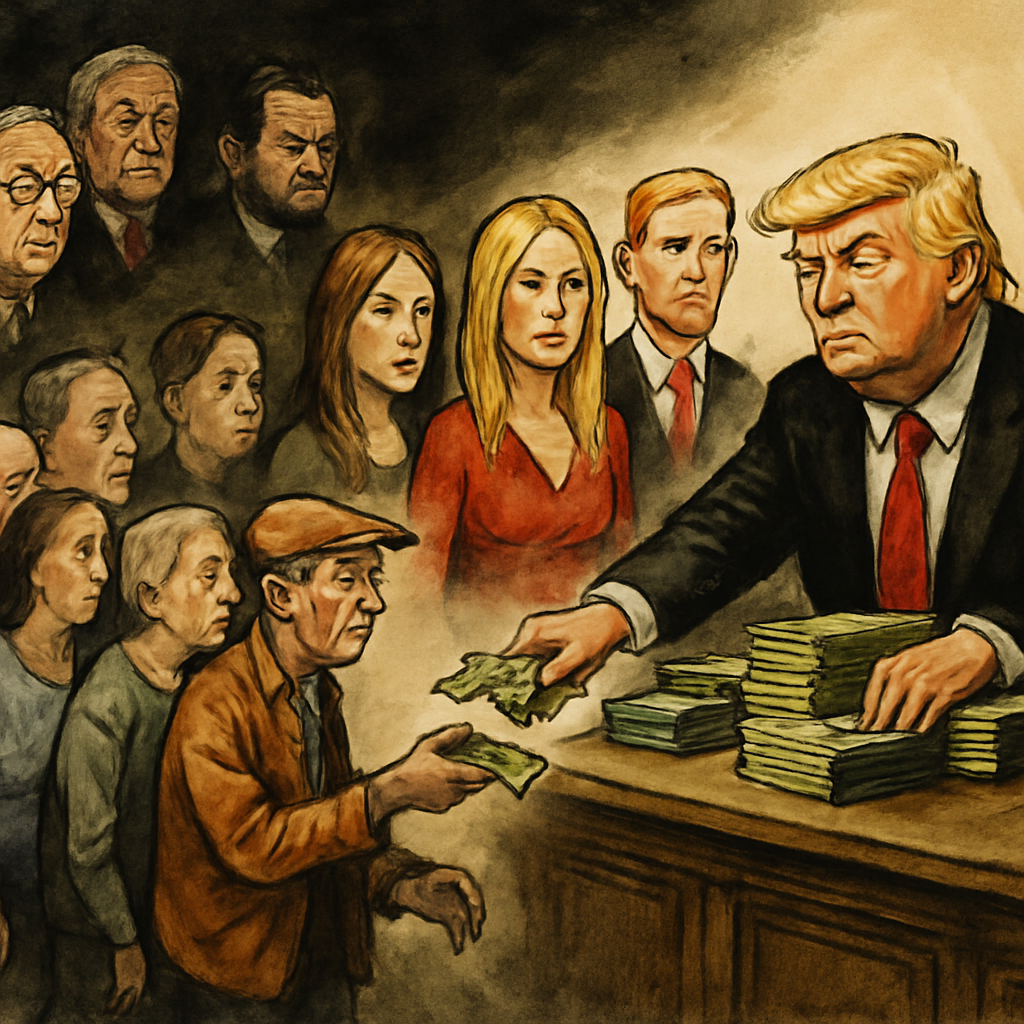
Donald Trump's businesses reported roughly $2.2 billion in revenues for 2025, his first year back in office, according to financial disclosures reviewed by the Guardian. His June filings showed at least $1.4 billion of it came from cryptocurrency ventures alone: about $799 million from World Liberty Financial, the decentralized-finance firm he launched with his three sons and the family of Steve Witkoff, who now serves as Trump's special Middle East envoy, and roughly $636 million from the $TRUMP memecoin he began marketing days before his 2025 inauguration.
Forbes put his net worth at $6.5 billion in March 2026, up from $2.3 billion when he took office. Not doubled. Nearly tripled, in roughly a year, while sitting in the Oval Office.
Set the two figures side by side. The Biden family's foreign income, including associates and stretched across more than a decade, came to $17 million. Trump's disclosed 2025 revenue was more than a hundred and twenty times that, earned in twelve months, by a sitting president rather than the relative of one.
Larry Noble, former general counsel at the Federal Election Commission and now a law professor at American University, put it plainly: "In just the first year of this term, he reported his business holdings earned over $2bn." His assessment is that "while Trump's second term is less than half over, it already looks like the most overtly corrupt administration in our history."
Who paid, and who lost
Revenue alone is not corruption. Presidents are allowed to be rich. The question the Comer standard asked was where the money came from, and whether public power was the product being sold.
On that question the record is not ambiguous. Trump called cryptocurrency a "scam" and "a disaster waiting to happen" in 2021. After the industry poured millions into his 2024 campaign, he pledged to make the United States "the crypto capital of the world" with lighter regulation, and then his family launched crypto ventures that became the single largest source of his income. Cornell economist Eswar Prasad describes the mechanism without euphemism: the administration "has clearly shifted the priorities and focus of the government's regulatory machinery to look past any and all sins of the crypto industry, thereby directly benefiting the Trump family's financial interests."
The clearest illustration runs through Binance. The exchange pleaded guilty in 2023 to violating U.S. money-laundering law and paid a $4.3 billion federal fine. Its founder, Changpeng Zhao, pleaded guilty to failing to maintain an anti-money-laundering program and served four months in prison. In 2025, an Abu Dhabi sovereign fund used $2 billion of World Liberty Financial's USD1 stablecoin, a Trump family product, to buy a stake in Binance. In October 2025, Trump pardoned Zhao.
Asked why, Trump said he had granted the pardon "at the request of a lot of very good people" who told him that what Zhao did "is not even a crime" and that he "was persecuted by the Biden administration."
That sentence deserves to be read twice. The president pardoned a convicted money launderer whose company had just transacted $2 billion with the president's family business, and justified it by invoking the corruption of his predecessor.
Meanwhile, the retail investors on the other side of these products did not do well. A February industry analysis cited by Senators Elizabeth Warren and Adam Schiff found that $TRUMP and the first lady's $MELANIA coin together erased an estimated $4.3 billion in retail wealth, leaving roughly two million holders underwater. The same report found that 45 crypto wallets holding early positions in $TRUMP profited by about $1.2 billion. Nobody has explained who those wallets belonged to.
Selling the office by subscription
If the crypto ventures monetized the presidency indirectly, Trump Media's newest product does it on a price list.
Trump Media told analysts on its first earnings call in August 2026 that it had signed more than ten customer agreements for "Truth API," a data feed delivering Trump's Truth Social posts to subscribers fractions of a second before the public sees them. Customers pay between $60,000 and $100,000 a month. Most are high-frequency trading firms.
The posts in question move markets. They announce tariffs, personnel changes, and policy reversals. The president is, functionally, selling advance access to his own market-moving announcements, to the firms best equipped to trade on them, for his personal benefit. The company reported a $238 million loss for the quarter ending in June, which is presumably part of the motive.
Senator Mark Warner wrote to six major Wall Street trade associations in July urging them not to "legitimize an arrangement that sells privileged access to market-moving presidential communications, especially for the president's personal financial benefit." Warren and Schiff asked the SEC to determine whether the arrangement violates securities law, calling it "an outrageous abuse of the President's office for his personal benefit." The Intercept sued on constitutional grounds in August.
Virginia Canter, chief counsel for ethics and anti-corruption at Democracy Defenders Action, called it "a significant escalation in exploiting and monetizing the presidency," and warned it is "a step toward normalizing insider trading and public corruption."
The sons, the son-in-law, and the standard that moved
The Biden investigations were, at bottom, about a president's son trading on the family name. It is difficult to construct a version of that argument that does not apply with greater force to the current first family.
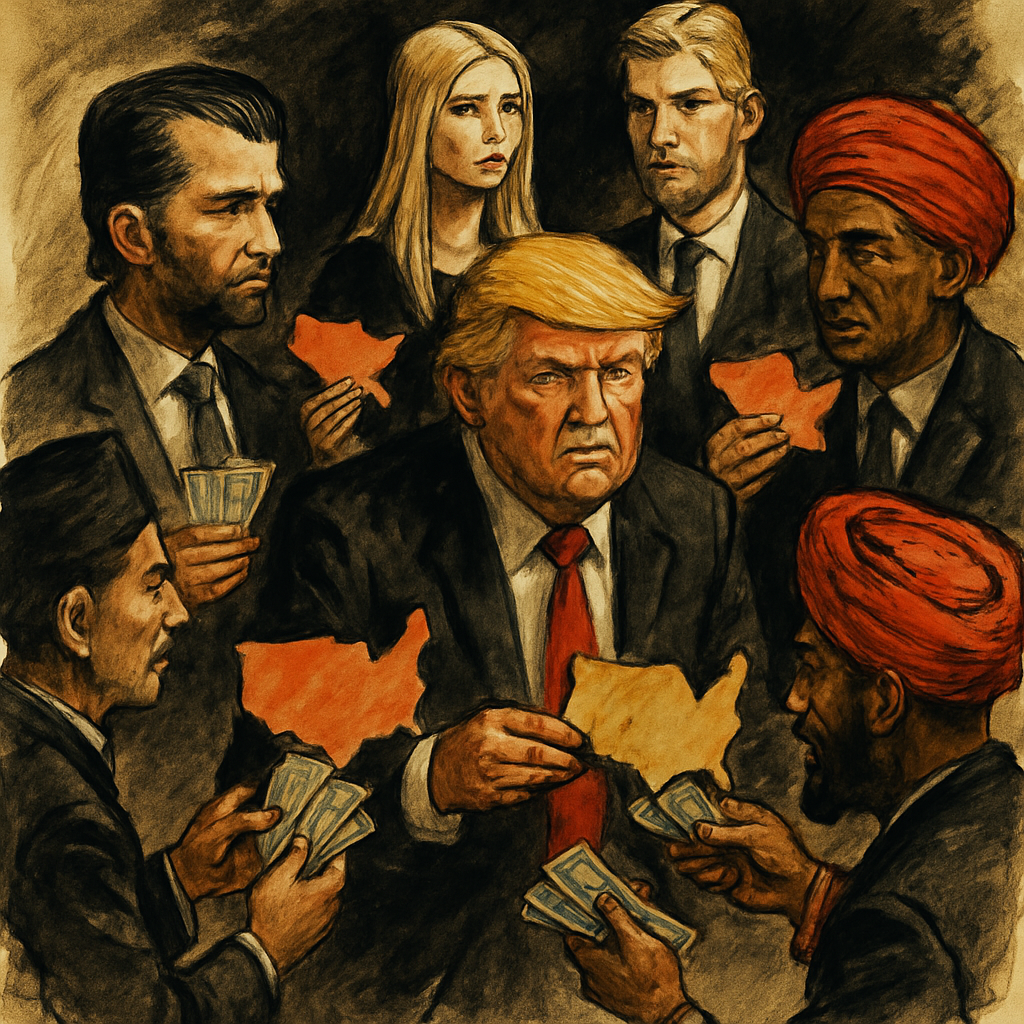
Donald Trump Jr. and Eric Trump are co-founders of World Liberty Financial, the source of some $799 million in 2025 revenue tied to their father's disclosures. Eric Trump serves as chief strategy officer of American Bitcoin, a mining and treasury venture built from Hut 8's mining business, which held roughly 7,300 bitcoin worth about $583 million after the first quarter of 2026. Both sons run these businesses while their father's appointees write the rules governing the industry they operate in.
Jared Kushner secured a $2 billion investment from Saudi Arabia's Public Investment Fund months after leaving the White House in 2021, over the written objections of the fund's own screening panel, which flagged his firm's inexperience, inadequate due diligence, an excessive fee structure, and reputational risk arising from his government service. The full board, chaired by Crown Prince Mohammed bin Salman, overruled the panel. The management fees alone have been estimated at roughly $40 million a year. Kushner now serves as a special envoy negotiating in the same region where his fund's largest backer sits. House Judiciary Democrats wrote to him in April 2026 about exactly that conflict.
And then there is the airplane. In May 2025 the United States accepted a Boeing 747-8 from Qatar, valued near $400 million, for use as Air Force One. The Foreign Emoluments Clause forbids federal officials from accepting gifts from foreign states without the explicit consent of Congress. Congress never gave it. The White House long maintained the aircraft would eventually go to Trump's presidential library, until Eric Trump told NBC News in August 2026 that it would not, leaving the most expensive foreign gift in American history without a stated destination.
What actually changed
Joe Biden pardoned his son in December 2024, a sweeping grant covering any offense from January 2014 through that date, after promising he would not. While it may have been an abuse of the pardon power, and it was widely condemned by Democrats as well as Republicans, it's not hard to imagine Trump and his corrupt personal DOJ adding him as a stop on his revenge tour.
Eleven months later Trump pardoned a man convicted of money laundering whose exchange had just done $2 billion in business with his family's stablecoin.
The difference between these acts is not that one was corrupt and the other was not. The difference is that only one of them was followed by a congressional investigation.
Princeton historian Julian Zelizer's assessment is the one that will likely survive: "In the first term, he created the thinnest of firewalls between his business and policy. In the second term, he didn't put up any firewall and smashed all guardrails that existed. The precedent is dangerous in general, as we're moving to a virtually unregulated era where there will be endless opportunities for corruption."
The public appears to have noticed. A CNN poll in late July found 66 percent of respondents saying Trump does not put the good of the country over his personal gain. Only 34 percent said he does.
Former federal prosecutor Barbara McQuade argues the answer is structural: "new rules and new penalties to protect the public from a president willing to put his own financial benefit ahead of the public interest." She is right that the law is inadequate. But the deeper failure is not statutory. It is that a party which spent four years insisting that monetizing proximity to the presidency was disqualifying has decided, on discovering that the president is doing it himself and at vastly greater scale, that the principle was never really a principle.
A standard that applies only to your opponents is not a standard. It is a weapon. And weapons, unlike standards, are laid down the moment they stop being useful.