The Vice President Is Touring a Book About His Faith. At the Nixon Library, He Explained Why Lying No Longer Costs Anything.
Promoting "Communion: Finding My Way Back to Faith," JD Vance told an audience that Watergate would be "a 12-hour news story" today and that the "deep state" took down Nixon. He was not warning about that. He was counting on it.
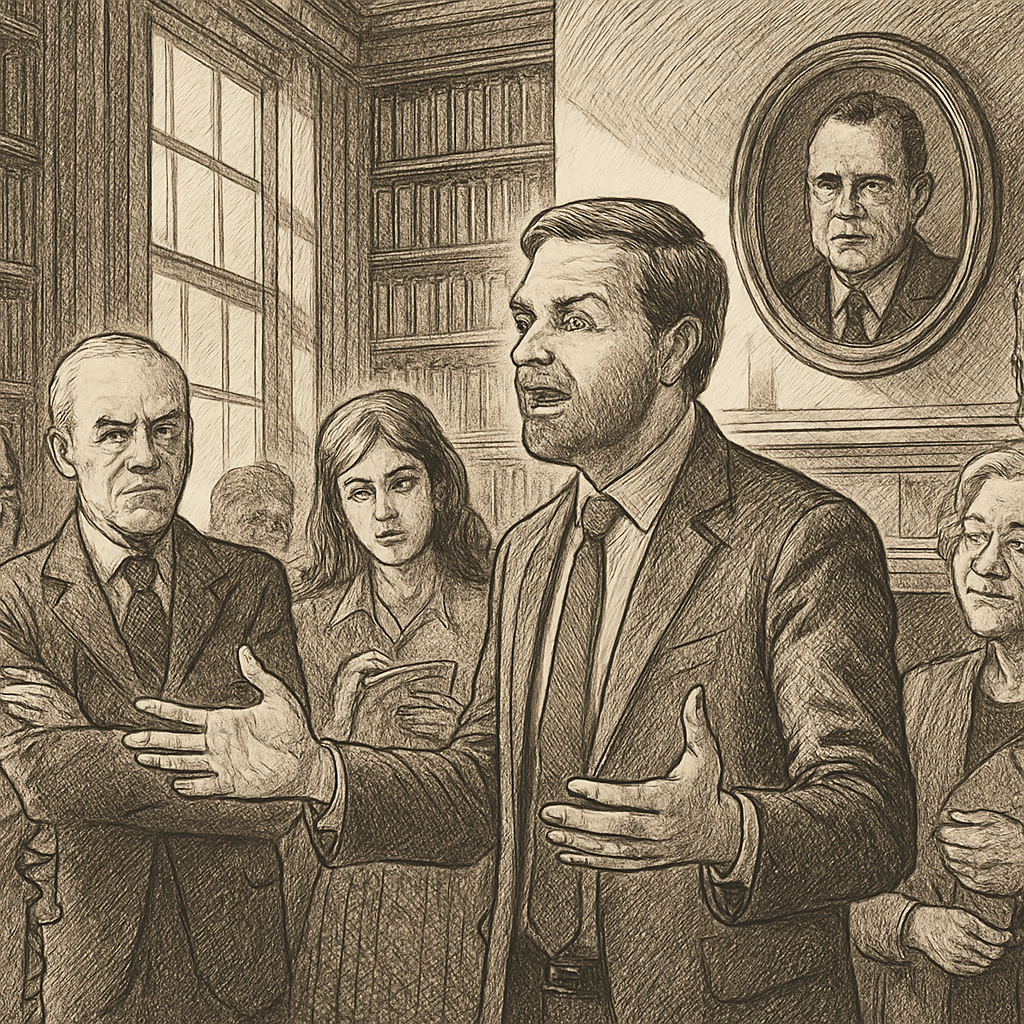
On June 25, Vice President JD Vance sat for a friendly conversation at the Richard Nixon Presidential Library in Yorba Linda, California. He was there to sell a book about coming home to God. What he offered the room was the opposite sermon: that the most documented political crime in American history would barely dent a single news cycle now.
"If Watergate happened tomorrow, it would be like a 12-hour news story," Vance said. "The idea that it would have taken down a presidency is crazy." Then he recast the scandal as a frame job: "If you look at the story of how the deep state took down Richard Nixon. It is not all that different from what the same groups of people and institutions tried to do to Trump in the first Trump administration," he told the audience.
Read those two sentences as a single thought, because that is how they were delivered. A break-in, a cover-up, hush money, and subpoenaed tapes are reduced to a passing headline, and the man who resigned rather than be removed becomes the victim. This was not a slip at a rope line. It was the message, said slowly, to an admiring room, on camera, by the sitting vice president of the United States.
The "12-hour" line is not an observation. It is a plan.
Strip the nostalgia and what Vance described is a method. He is not mourning a country with a short attention span. He is telling you he has measured it. A scandal that once ran for two years and ended a presidency now lasts, by his estimate, half a day, and the lesson he draws is not "we should fix that." The lesson is that you can wait it out. Deny, change the subject, let the next outrage arrive on schedule, and the short half-life of public attention does the rest.
That is a confession of strategy dressed as media criticism. And you do not have to take a partisan's word that Watergate was real corruption rather than a "deep state" operation, because the people who ended Nixon were not spies. They were Republicans. On August 7, 1974, it was Barry Goldwater, the conservative movement's own standard-bearer, who walked into the Oval Office with the Senate and House GOP leaders and told Nixon he had perhaps 16 votes left in the Senate, far too few to survive. Nixon announced his resignation the next day. The "deep state" in this story was Barry Goldwater.
A book about faith, a tour about why none of it matters
Here is the part that should land with anyone, of any party, who takes religion seriously. The book in Vance's hand is "Communion: Finding My Way Back to Faith,") a HarperCollins memoir, published June 16, about his 2019 conversion to Catholicism. In it, he performs the small rituals of accountability. He calls his "childless cat ladies" remark "one of the dumbest things I ever said" and "boneheaded." He writes that part of Christian maturity is learning "it's ok to admit error."
It's ok to admit error. He wrote that, and then on the tour for the book that contains it, he stood at the Nixon Library and said the error at the center of Watergate, the cover-up a president resigned over, was essentially nothing, a media event the modern news cycle would digest before lunch. The contrition extends to a tweet about cat ladies. It does not extend to obstruction of justice. A man can apologize for a bad line and, in the same week, tell a room that breaking the law and lying about it is a public-relations problem with a known expiration date.
You can hold those two things next to each other without calling anyone a heretic. Vance's own church has done it for us. Catholic writers, including at the National Catholic Reporter, have argued that the politics do not match the profession of faith. The point is not that Vance is a bad Catholic; that is between him and his confessor. The point is narrower and harder to wave off: the same voice selling a story of moral return is the voice telling an audience that moral accountability is obsolete.
Meanwhile, the actual job
Then there is the timing, and what the vice president had circled on his calendar. Vance ran this book tour through a stretch when the country was at war. At the end of February, the administration launched what it called major combat operations against Iran. By late June, Vance was moving between television hits and negotiating tables, telling NBC News he was "feeling good" after a week of selling his book and brokering a deal to wind the war down.
For most Americans, that war is not an abstraction on a book jacket. It is the pump. Gas prices have risen roughly 50 percent since the strikes on Iran began at the end of February, according to CBS News. Overall inflation hit 4.1 percent in May, the steepest annual rise since April 2023. Food insecurity is at levels not seen since 2020. Health care is now Americans' top financial worry, after Congress let Affordable Care Act subsidies lapse and the average family premium climbed toward $6,900.
So the picture is a vice president doing daytime television to move copies of a memoir about his soul, in the weeks the prices of gas, groceries, and coverage were squeezing the people he governs, partly because of a war he is now taking credit for resolving. That is not an insult. It is the schedule.
Who is paying for the tour, anyway
It is fair to ask who funds a sitting vice president's book promotion, and the honest answer is: partly you. A vice president does not travel alone. The flights, the motorcades, and the Secret Service detail that follow him to a studio in Manhattan or a presidential library in California are public expenses whether the stop is official business or a book sale whose royalties he keeps. The administration has not itemized what the "Communion" tour has cost taxpayers, and that silence is itself worth noting. The arrangement is the familiar one: a public office, a private payday, and a bill the public never gets to see.